
Your needs, this model
Does it fit your priorities?
Does the five-meal name give me five future programmed openings?
No. The instructions permit four daily programmed meal times. The fifth compartment is meal zero, available initially, so it should not count as a fifth future release.
Explore this need in the finder →Can I use it for wet meals without app setup?
The maker lists wet food and local digital programming. Two ice packs provide passive cooling; plan the food's holding conditions separately and do not treat the timer as a refrigeration guarantee.
Explore this need in the finder →Can it run where there is no outlet?
Yes. Three AA cells are its normal power source, keeping the timer independent of mains. Follow the exact battery-changing instructions and check the clock and bowl alignment afterward.
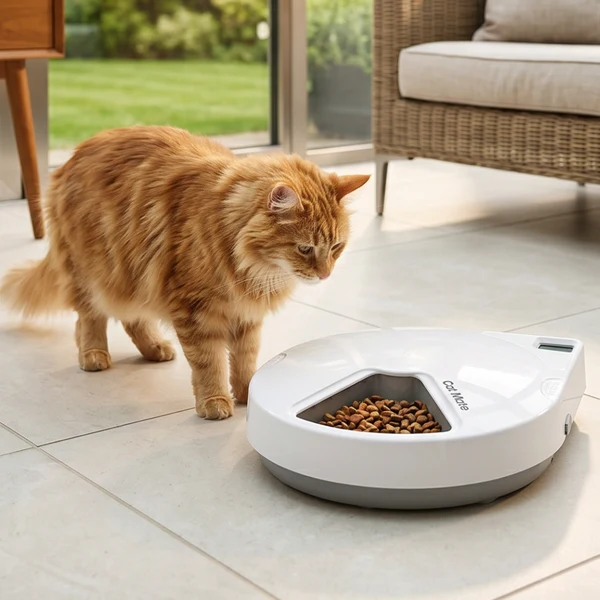
Explore this need in the finder →The Cat Mate C500 is a useful option for several prepared wet or dry meals without Wi-Fi setup. Its digital timer rotates a compartment into the opening rather than dispensing food from a hopper. The key limit is four programmed mealtimes: the fifth compartment is the initially available meal, not a fifth future timer.
Count the future openings before choosing it
The manufacturer's instructions explicitly permit up to four daily meal times. You can use fewer times to spread the four waiting servings over a longer period, while compartment zero can hold a meal available immediately. This makes the C500 a different proposition from a hopper feeder with many recurring daily releases. Cat Mate C500 operating instructions.
For example, two future mealtimes in a day use two of the loaded compartments. You still have to return to replenish food; the timer does not refill an empty section. The instructions sort set times into chronological order and use ten-minute increments, which is worth checking if your routine needs finer timing.
Its practical appeal is that each serving can be prepared separately. You can see what you loaded rather than rely on a motor's portion setting. This is useful when comparing tray and hopper formats, although it is not evidence that the appliance can choose a medically appropriate portion.
Food flexibility comes with a preparation routine
The US manufacturer page lists wet, dry and mixed meals. Two reusable ice packs fit under the rotating bowl. They need freezing before use; the instructions specify at least six hours and explain when the packs should be fitted.
Those packs provide passive cooling. They do not make the C500 an actively refrigerated appliance, and the timer's ability to wait several days should not be read as a safe holding duration for any wet food. The instructions specifically advise against leaving wet food for long periods in very warm conditions and direct owners to the food manufacturer when uncertain.
If powered cooling is an essential questionnaire answer, choose that mechanism deliberately. The C500 is better understood as a prepared-meal timer with ice packs, not a refrigerator that happens to have a rotating tray.
One capacity question still needs checking
The current Closer Pets page gives conflicting compartment capacities: 330 g or 11.5 oz in its main presentation, and 155 g or 0.34 lb in Key Features. Confirm the usable tray capacity for the exact version before buying if your prepared meals are close to either figure. C500 manufacturer product page.
This does not prevent comparing its four timers, battery operation and food format. It means capacity should not decide a strict match until the conflicting number is resolved. Also avoid overfilling: the rotating lid needs clearance to move correctly.
Local control and ordinary battery power
Three AA batteries power the feeder. The LCD shows the clock and the programmed meal indicators, so setup takes place at the device rather than through an account or wireless network. Normal battery operation keeps the timer independent of mains; those primary cells should not be confused with a separate emergency backup system.
The manual gives specific battery-change steps for preserving the clock and meal settings. Follow the instructions for your unit, then check the clock, upcoming opening and bowl alignment. The manufacturer's long battery-life estimate does not remove that small maintenance job.
More compartments do not identify more pets
The C500 presents food through one accessible opening. Its multiple compartments hold different future meals, rather than provide simultaneous bowls or selectively open for an implanted chip. A second cat can still approach an exposed serving.
The lid and bowl are dishwasher-safe; the base is wiped clean and must not be immersed. Allow time to wash, dry, reload and realign the tray rather than treat it like a hopper that can stay filled indefinitely.
Shortlist the C500 when four future openings, pre-portioned food and a local battery timer match the routine. The simpler C200 may be enough for two openings. An app-managed hopper solves a different dry-food problem, while an identity-access model addresses food stealing. Choosing the right job matters more than the five-meal name.
Key details at a glance
| Dry-food compatibility | Yes |
|---|---|
| Wet-food compatibility | Yes |
| Timed meal releases | Yes |
| Ice-pack arrangement | Yes |
| Local meal-schedule programming | Yes |
| Routine battery operation | Yes |
| Separate simultaneous feeding positions | No |
| Maximum documented scheduled meals per day | 4 |
| Future meal openings per filled load | 4 |
Use the exact model’s instructions for operating limits, supplied equipment and version differences.
Sources for this assessment
Compare the options for your routine.
Bring together the food, feeding function, controls and power that matter to you.