
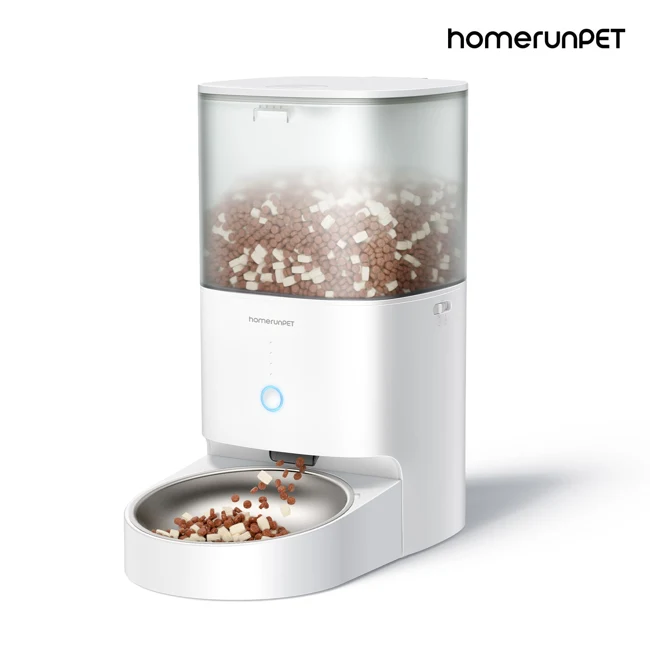
Your needs, this model
Does it fit your priorities?
Can PF20 normally run on batteries after the timetable is set?
The manual permits adapter or four-D-cell operation and the current maker page promotes battery placement. Establish the app plan first, then verify scheduled feeding in battery mode.
Explore this need in the finder →Can I keep remote feeding while using only its D batteries?
No. The original guide expressly says remote feeding is unavailable on battery-only power. Choose outlet-powered use for the documented connected routine.
Explore this need in the finder →Does PF20 offer eight daily meal times or twenty?
The current specification gives one to eight scheduled daily meals and up to twenty portion units per meal. The larger figure is not the number of daily time slots.
Explore this need in the finder →A battery-capable feeder whose remote features need a different power mode
The Homerunpet PF20 is worth considering when you want an app-created dry-food plan but may later place the feeder away from an outlet. The manufacturer documents both adapter and D-cell operation, and its current product reference promotes routine battery placement. The important catch is that remote feeding is unavailable when it is powered only by batteries.
That makes the PF20 more specific than either a generic smart feeder or a generic battery feeder. It can fit a stored timetable in a location where a cord is inconvenient. It cannot provide the same documented remote-control experience in that location that it offers while adapter-powered. Decide which mode you will actually use before combining those two requirements.
Set the plan in the app before choosing its final location
The operating guide instructs you to install the Homerunpet app, create or sign into an account and connect the device before customizing the feeding plan. The physical manual-feed button releases a portion when double-clicked. That is useful for a test or extra release, but it is not an app-free way to enter the full timetable.
The exact product reference lists one to eight scheduled meals a day and up to twenty portion units per meal. These are separate limits. Eight is the daily scheduling capability; twenty is the amount-setting range for an individual release. Neither number specifies the right feeding routine for a particular cat.
The manual identifies 2.4 GHz Wi-Fi. Do not assume that a 5 GHz-only setup will work merely because a phone can connect to it. Pair and check the feeder with the intended home network, then verify the actual stored plan rather than treating successful account registration as proof that meals have been saved correctly.
The food and hopper are suited to one dry-food supply
The PF20 has a four-liter reservoir. Its English food instructions call for dry kibble no larger than 12 mm. A complete minimum-size interval is not supplied here, so very small pellets and unusual shapes still need an observed dispensing check. Wet-food compatibility is not established by this dry-hopper documentation.
The manufacturer also notes that different kibble sizes can produce small differences in each portion. Check the actual output for the chosen food and setting instead of treating a portion unit as an exact weight. A hopper that is large enough for the plan still needs refilling and inspection; no storage-duration headline determines how long the cat can appropriately be left without someone checking.
There is one reservoir serving one open bowl. The lid and outlet sealing arrangement concern stored food, not selective access after a meal is served. In a multi-cat home, consider whether one animal can reach food intended for another. This is not resolved simply by scheduling more releases.
Battery placement comes with a real functional tradeoff
Four separately purchased LR20 D alkaline cells can power the feeder, and the guide describes automatic battery supply when adapter power is interrupted. The current maker page advertises a six-month battery-life figure and placement flexibility. Treat that as a manufacturer runtime claim rather than an independently measured result for every battery, meal pattern or environment.
The manual is clear that battery-only operation does not support remote feeding. It also explains that indicators can be off during battery standby, so an unlit panel is not by itself proof of a failed feeder. Check the actual operating state and cell condition using the supplied instructions.
For full remote use, the documented adapter output is 5V, 2A. If you intend to use the battery mode for normal placement, establish the plan first and observe scheduled meals in that mode before relying on it. It can satisfy a routine-battery requirement while failing the combined requirement for routine battery operation and app-controlled remote feeding.
Bowl options and careful cleaning
The current PF20 page distinguishes porcelain and stainless-steel bowl versions. Choose the actual package you want rather than assuming every PF20 offer includes both materials. The feeder body and operating method are the shared focus here; the bowl option remains a package detail to confirm.
The guide provides a detailed disassembly sequence for the hopper and impeller parts. Its English cleaning directions say to wipe the lid and powered base rather than wash them, hand-wash the designated washable parts and let everything dry before reassembly. Do not turn a broad full-disassembly marketing claim into permission to put the entire machine in water or a dishwasher.
Who should choose the PF20?
Keep it on the shortlist for compatible dry food, an app-created plan of up to eight daily meals and either powered remote use or a deliberately limited battery routine. Compare a local timer if initial app setup is unwanted, a different connected design if remote feeding must work on routine battery power, or selective access when protecting another cat's food is the actual goal.
Sources: Homerunpet PF20 product specification and bowl options and original PF20 operating guide, English sections.
Key details at a glance
| Dry-food compatibility | Yes |
|---|---|
| Timed meal releases | Yes |
| App plans or food targets | Yes |
| Local meal-schedule programming | No |
| Routine battery operation | Yes |
| Backup for stored meal schedules | Yes |
| Separate simultaneous feeding positions | No |
| Separate food hoppers | No |
| Maximum documented scheduled meals per day | 8 |
| Dry-food hopper volume | 4 L |
| Documented upper regular-kibble boundary | 12 mm |
Use the exact model’s instructions for operating limits, supplied equipment and version differences.
Sources for this assessment
Compare the options for your routine.
Bring together the food, feeding function, controls and power that matter to you.