
Your needs, this model
Does it fit your priorities?
Can I schedule dry meals remotely without buying a camera feeder?
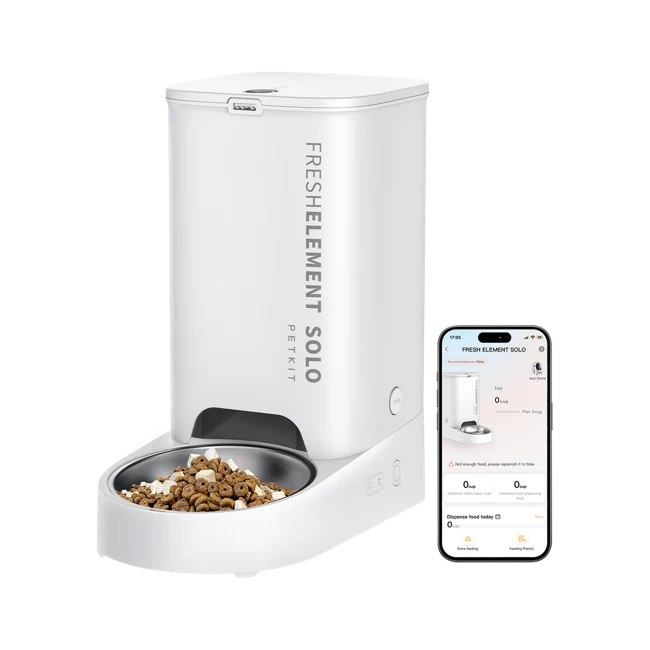
P570 uses the PETKIT app and 2.4 GHz Wi-Fi for its feeding plan. The 3L hopper serves one open bowl; remote scheduling does not identify which cat eats.
Explore this need in the finder →Will the timetable survive a short outage?
PETKIT documents stored-schedule dispensing with five separately purchased AAA alkaline backup batteries. That does not promise remote app access during the outage.
Explore this need in the finder →Can I create the feeding schedule using only the button on the feeder?
No. The documented button releases food manually; the schedule is set in the app. Choose an explicitly locally programmed model for app-free initial setup.
Explore this need in the finder →A compact app feeder for an established dry-food routine
The PETKIT Fresh Element Solo P570 is a useful starting point when you want to schedule one cat's dry-food meals from your phone, without making a camera or a second food reservoir part of the purchase. Its three-liter hopper is the practical middle ground: enough storage to avoid refilling after every meal, but still a single container feeding a single open bowl.
The important question is whether that arrangement matches the problem you want to solve. It can move dispensing to a timetable. It does not establish which animal eats from the bowl once food is served. In a household where one cat steals another's diet, investigate documented selective-access feeding rather than assuming an app schedule solves the competition.
Measure the food, then check the portion setting
The current US reference permits dry kibble up to 12 mm and gives freeze-dried pieces a separate 9 mm maximum. Do not apply the regular-kibble figure to a larger freeze-dried treat. Shape and texture also matter, so try the intended food through repeated observed meals before depending on a new routine. This is a dry-food dispenser, not a chilled wet-food tray.
The page lists one to five portions per meal and describes a portion as approximately 10 grams. That estimate is not a measurement of the food in your own bag. The manufacturer manual explains that the mechanism measures volume and that pellet size, density and a low food level can change the dispensed weight. Check actual output after choosing a setting, and again after changing food.
Hopper capacity should be treated in the same way. Three liters is a storage volume, not a promise of a particular number of days for every cat. Your chosen food, feeding plan and refill level decide how long a fill lasts. No verified maximum number of scheduled daily meals is used here; the portion settings are a different specification.
App setup and an offline schedule are different things
Initial scheduling uses the PETKIT app and a compatible 2.4 GHz Wi-Fi connection. The physical feeding button can release food manually, but it is not a full on-device schedule editor. Choose the local-programming answer in the finder only if you need to create the timetable without an app; this P570 does not supply that documented route.
Once a schedule has been stored, PETKIT says it continues while the feeder is offline. That is useful if internet access fails after setup. It does not mean you can keep changing the plan or checking live status without connectivity. The older operating manual specifically separates continued dispensing from unavailable app communication and incomplete feeding-log updates.
Check the power edition before plugging it in
The current US listing specifies a USB supply with 5V, 1A output and says the power adapter is not included. An older official P570 manual instead lists a supplied adapter and a 6V rating. Because both carry the P570 identity, follow the rating label and instructions supplied with the particular unit; do not substitute an adapter solely because it fits a connector or appears in an older document.
Five separately purchased AAA alkaline batteries provide the documented backup arrangement. PETKIT says the stored timetable continues in an outage when those batteries are installed. Check their condition before they are needed. Backup dispensing is not a reason to assume normal app functions survive a power cut, particularly when the home router also loses power, and this assessment does not establish routine battery-only operation.
Cleaning is part of keeping the small system useful
The removable food container, lid and stainless-steel bowl make the feeding path accessible. In the older operating instructions, these parts are cleaned individually and dried before reassembly, while the powered main unit must stay dry. A detachable hopper is useful only if it is reseated properly afterward; check the latches and run an observed dispense after cleaning.
The enclosed outlet, lid lock and desiccant are storage features. They do not turn the open serving bowl into pet-specific access control or prove food freshness for an unattended interval. Keep a refill and cleaning routine that suits the actual food and check that meals are reaching the bowl.
When the Solo is the right choice
Shortlist the P570 for compatible dry food, phone scheduling, a 2.4 GHz setup and a single feeding station. Compare a locally programmed feeder if app-free initial setup matters, a documented camera model if watching meals is essential, or a dual-hopper design if you genuinely need separate dry-food storage. The Solo's value is a focused schedule-and-hopper arrangement, provided its food and power requirements fit your home.
Sources: current PETKIT P570 US specifications and FAQ and official 2022 operating manual, English section.
Key details at a glance
| Dry-food compatibility | Yes |
|---|---|
| Wet-food compatibility | No |
| Timed meal releases | Yes |
| App plans or food targets | Yes |
| Local meal-schedule programming | No |
| Backup for stored meal schedules | Yes |
| Separate simultaneous feeding positions | No |
| Separate food hoppers | No |
| Dry-food hopper volume | 3 L |
| Documented upper regular-kibble boundary | 12 mm |
Use the exact model’s instructions for operating limits, supplied equipment and version differences.
Sources for this assessment
Compare the options for your routine.
Bring together the food, feeding function, controls and power that matter to you.