
Your needs, this model
Does it fit your priorities?
Can I use two dry foods with a 5 GHz network and watch the bowl?
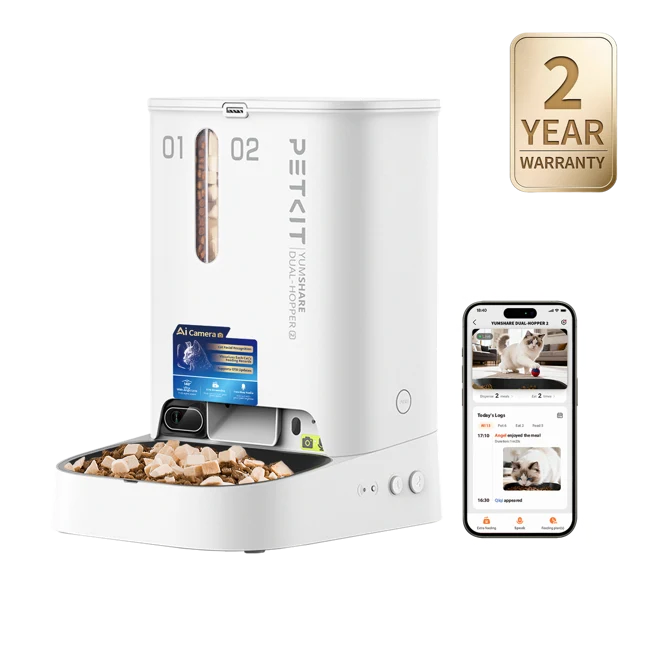
P592 documents both Wi-Fi bands, a camera and two reservoirs feeding one bowl. Its two-liter and three-liter stores are separate before dispensing; they do not create two protected meals.
Explore this need in the finder →Does facial recognition stop my other cat from taking the food?
No. The advertised recognition identifies pets in camera events; it does not lock the single feeding station to a particular cat. Separate diets need a suitable access-control or separation solution.
Explore this need in the finder →Will the backup batteries keep the camera running during an outage?
No. PETKIT says the saved feeding plan continues on emergency batteries but the camera automatically turns off. Use mains power for normal camera operation.
Explore this need in the finder →A better network fit, with the same important bowl distinction
The PETKIT YumShare Dual-Hopper 2 P592 brings together two dry-food reservoirs, an app and a camera at one feeding station. Its documented support for both 2.4 and 5 GHz Wi-Fi is a meaningful difference from the original P591. Choose the exact P592 when that network requirement matters; the shared YumShare name alone is not enough to identify the generation.
This is still a single-bowl feeder. Keeping two foods separate before dispensing can make a routine easier to manage, but it does not create two independently protected meals. If one cat must never eat the other's diet, start with selective access or separated feeding arrangements rather than camera features.
Plan the smaller reservoir first
The five-liter total consists of a two-liter first hopper and a three-liter second hopper. Consider the amount used from each side over the same period. A frequently dispensed food can empty its reservoir while the other side still looks well stocked. The useful question is when the next required ingredient will run out, rather than how long five liters might last in theory.
Each side has its own portion setting. Test both foods separately and then the intended combination so that you understand what a release produces. A setting is a dispenser unit, not a guaranteed gram weight across differently shaped foods. Do not use the reservoir ratio as a substitute for a feeding plan appropriate to your cat.
The current FAQ says regular dry kibble should be smaller than 12 mm and freeze-dried pieces smaller than 9 mm. The manual uses inclusive limits, so choosing food comfortably below the stricter FAQ boundaries avoids relying on an ambiguous endpoint. This is a dry-food machine, not a place to store canned meals.
What the camera can tell you
PETKIT promotes facial recognition for distinguishing pets in camera records. That can help you look through events involving different cats, but it is video identification, not an access lock. A cat identified by the camera is not thereby prevented from eating food intended for another animal.
The before-and-after meal images are useful as visual context. They should not be read as an independent measurement of exactly how many grams a particular cat consumed. An image can prompt a closer check; it cannot by itself settle whether another pet ate the missing food or whether the bowl was moved.
Live viewing also answers a different question from reviewing earlier footage. The manual connects full recorded clips and certain playback functions to PETKIT Care+. If you mainly want to check a live scene, that is a simpler requirement than retaining a detailed history. Read the current service terms before making recorded evidence the main reason for choosing this feeder.
Camera privacy is part of placement
The app supports camera time periods, a camera-off setting, microphone control and an initial live-frame privacy blur. Decide which household areas should be visible before putting the feeder in its permanent place. A narrow view of the bowl can be more appropriate than a view across a room that people regularly use.
These controls are worth checking with anyone who will share the device. Switching a camera off also means losing the footage it would otherwise capture. Choose settings deliberately rather than expecting both complete privacy and a continuous visual record at the same time.
Outage feeding is narrower than outage monitoring
The normal supply is the specified original 6V adapter. Four D alkaline batteries are an emergency backup, not the intended sole power supply. PETKIT explicitly says the camera shuts off when the feeder runs only on batteries, while the saved feeding schedule continues. A successful backup meal therefore does not imply that a corresponding video will exist.
This makes P592 a poor choice for a location without a usable outlet if remote observation is essential. It can be a more appropriate choice beside an outlet where the batteries protect the timetable during an interruption. Check the stored schedule and battery condition before depending on that arrangement; a previous app connection alone is not the same as a verified saved plan.
App setup and cleaning remain real commitments
The timetable is configured through the app. The local food-release buttons are useful for dispensing but do not replace full app-based setup. Households wanting to program an entire routine without an account or network should compare a feeder with documented local scheduling.
Cleaning involves more than lifting out the bowl. The manual shows removal of the partition and food-path components, washing the designated removable parts and drying them completely before reassembly. Keep the powered main unit out of water. With two foods, also consider whether both paths have been cleared before changing what goes into them.
P592 is a useful match for app-based dry feeding with two reservoirs, dual-band Wi-Fi and camera visibility. Choose it for those concrete advantages. Choose another arrangement for two separately defended diets, wet food or full camera operation without mains power.
Sources: PETKIT P592 product details and FAQ and P592 manufacturer manual, October 2025 edition.
Key details at a glance
| Dry-food compatibility | Yes |
|---|---|
| Wet-food compatibility | No |
| Timed meal releases | Yes |
| App plans or food targets | Yes |
| Integrated camera | Yes |
| Local meal-schedule programming | No |
| Routine battery operation | No |
| Backup for stored meal schedules | Yes |
| Separate simultaneous feeding positions | No |
| Separate food hoppers | Yes |
| Dry-food hopper volume | 5 L |
| Documented upper regular-kibble boundary | Under 12 mm |
Use the exact model’s instructions for operating limits, supplied equipment and version differences.
Sources for this assessment
Compare the options for your routine.
Bring together the food, feeding function, controls and power that matter to you.