
Your needs, this model
Does it fit your priorities?
Is the rechargeable battery a normal cordless power option?
No. PETLIBRO explicitly describes emergency backup, with a conditional up-to-24-hour estimate. A location without routine mains power needs a model documented for normal battery operation.
Explore this need in the finder →Will the bowl scale stop a second cat eating the food?
Bowl-weight monitoring provides information, not identity-controlled access. It does not establish which cat ate a serving or lock food away from an unrecognized pet.
Explore this need in the finder →Can it suit 5 GHz app control and ordinary 8 mm dry kibble?
The exact PLAF105 specification supports both Wi-Fi bands and a 2–15 mm regular-kibble range. Food shape still matters, and the scale needs a hard, flat floor and calibration after reassembly.
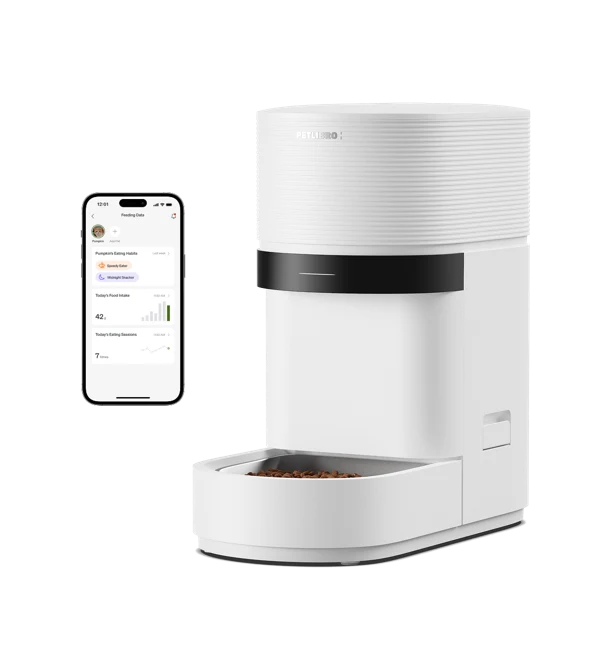
Explore this need in the finder →The PETLIBRO Granary 2 PLAF105 is worth comparing when dry-food scheduling alone feels too limited and you also want bowl-weight and eating-activity information. This review concerns the standard PLAF105 configuration, not every camera or recognition feature advertised elsewhere in the expanded Granary 2 Series.
What the bowl scale adds
The manufacturer describes tracking the food remaining in the bowl and changes in eating activity. That can be more informative than a log saying the motor was told to dispense. It is still an appliance's measurement, rather than proof of which animal ate each piece or a medical assessment of appetite.
For a home with several animals, consider whether you need observations or selective access. Bowl-weight changes cannot by themselves allocate food to a named cat. If the real problem is another pet taking a serving, an identity-access lid addresses a different requirement. PETLIBRO PLAF105 specification and support.
The location affects the measurement
PETLIBRO specifies a hard, flat floor and says the feeder is not suitable for carpet. That is a meaningful setup constraint for a scale-based device. Before choosing it, find a location that supports the whole unit properly and leaves space to remove and clean the bowl.
The maker recommends recalibrating the scale after disassembly and reassembly. Its 7.5 kg maximum scale load is not the hopper's food capacity or a recommended amount to put in the bowl. Treat calibration as part of cleaning, rather than assuming the first setup remains correct after every move.
Five liters of the right dry food
The exact PLAF105 specification lists a 5 L hopper and regular kibble from 2 to 15 mm. The maker separately warns about oversized or irregular pieces, including certain cubes and crescents. A diameter inside the broad range does not erase those shape exclusions.
The standard model is for dry kibble, not prepared canned meals. Choose a wet-food tray design if that is essential. For dry food, check several actual releases with the intended kibble and compare them with your existing portion plan rather than use a generic gram estimate as a feeding recommendation.
Connected control with an outage fallback
The documented network supports both 2.4 and 5 GHz Wi-Fi. Remote app control requires a working connection, while the maker says stored schedules keep running when the network is offline. An app temporarily losing contact does not necessarily mean the timer has stopped.
This generation has an included rechargeable backup battery, specified for up to 24 hours under the maker's test conditions. It is explicitly emergency backup rather than a normal cordless power plan. A no-outlet location should therefore not select it on the strength of the battery alone.
PETLIBRO's PLAF105 support describes Wi-Fi continuing during backup, which differs from older Granary backup behavior. The standard PLAF105 does not gain a camera or a newer model's recognition features from that power claim. Check the complete model and current package when comparing variants.
Maintenance includes more than the stainless bowl
The bowl, holder, food path and electronics have different cleaning requirements. Follow the actual instructions rather than assume a stainless bowl means the whole assembly is washable. Recalibrate as directed after putting the unit back together.
PETLIBRO also specifies two desiccant bags used together and recommends replacing them every 14 days. That is a recurring consumable task to include in the ownership routine, along with refilling and keeping the unit on the correct surface.
Choose the PLAF105 for dry-food scheduling plus the particular bowl-monitoring workflow, provided you can accommodate its floor and maintenance requirements. Choose an exact camera feeder when visual remote checking is essential, or a selective-access model to manage food stealing. More information about the bowl can be useful, but it should answer a real household question.
Key details at a glance
| Dry-food compatibility | Yes |
|---|---|
| Wet-food compatibility | No |
| Timed meal releases | Yes |
| App plans or food targets | Yes |
| Integrated camera | No |
| Routine battery operation | No |
| Backup for stored meal schedules | Yes |
| Separate simultaneous feeding positions | No |
| Dry-food hopper volume | 5 L |
| Documented minimum regular-kibble diameter | 2 mm |
| Documented upper regular-kibble boundary | 15 mm |
Use the exact model’s instructions for operating limits, supplied equipment and version differences.
Sources for this assessment
Compare the options for your routine.
Bring together the food, feeding function, controls and power that matter to you.