
Your needs, this model
Does it fit your priorities?
Will I still have live camera access when it changes to backup batteries?
The maker says Wi-Fi and camera functions are disabled on emergency cells, while stored meal schedules continue. Schedule continuity is not live-video continuity.
Explore this need in the finder →Can I depend on eight separate releases each day?
Not on the conflicting current page alone: its specification says up to ten and its FAQ still says six. Confirm the exact PLAF203/software limit before making eight essential; no maximum is assigned here.
Explore this need in the finder →Does the camera make the bowl open only for my cat?
A camera provides a view; it does not establish identity-controlled access. The reviewed PLAF203 single bowl is not documented as a microchip or collar-tag lock.
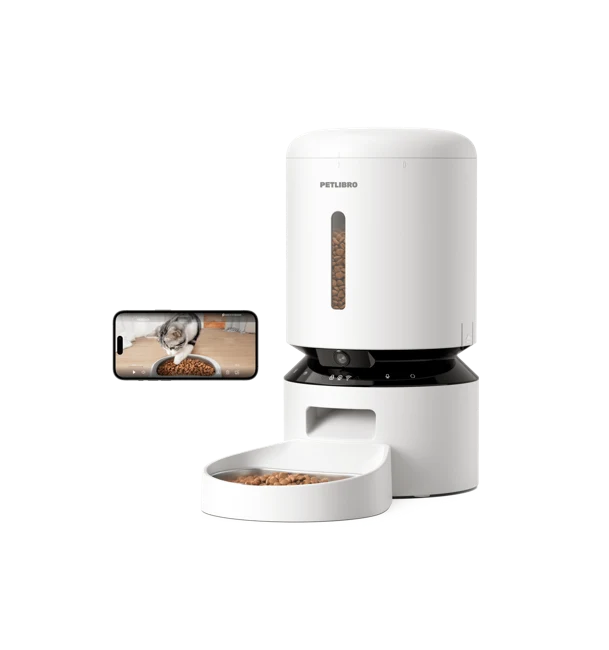
Explore this need in the finder →The PETLIBRO Granary Camera PLAF203 is worth comparing when you want to see the feeding area as well as schedule dry-food portions. This review concerns the single-bowl configuration. Its camera is the useful difference from a simple connected hopper, while power interruptions and recording arrangements limit what remote monitoring can promise.
A view of meals, not proof of everything eaten
The exact manufacturer description specifies a built-in 1080p camera, night vision and a downward-facing 145-degree view. That is intended to show the feeder and the animal nearby, rather than cover an entire room like a general security camera. PETLIBRO PLAF203 manufacturer details.
Think about the question you want the picture to answer: whether a pet approached the bowl, whether food appears present or what is happening around a meal. A visible visit is not a measured food intake, and the camera does not selectively lock the bowl to an identified cat.
The model also documents two-way audio and configurable motion or sound alerts. Those can support remote checking, but they do not establish how your particular cat will respond to a voice or how accurately an alert will identify an event.
Live viewing and saved video are different choices
Before ordering, decide whether live access is enough or whether you need recordings afterward. PETLIBRO's FAQ distinguishes cloud services from microSD recording and says files stored on the card are viewed through Replay in the app, rather than treated as ordinary files for direct computer playback.
Batteries and a microSD card are not included in the documented package. Check the recording option, current service terms and compatible equipment you intend to use. A camera specification by itself does not promise every recording feature without additional setup.
The food path is still a dry-food hopper
The PLAF203 has a documented 5 L reservoir and a regular dry-kibble diameter range of 2–15 mm. The maker explicitly excludes wet food. The camera does not change the food path into a refrigerated or wet-food-compatible device.
Check several initial releases with the intended food and look at actual serving amounts. Manufacturer portion-volume and approximate weight figures are useful setup references, not a feeding prescription or a tested guarantee for every kibble.
Although the same product page offers single- and dual-bowl styles, this assessment follows the single stainless tray package. The dual style has a splitter and its own configuration. Two bowls would still not identify which cat receives which amount.
Confirm the meal limit if frequency is essential
The current specification says one to ten scheduled meals, while the FAQ on the same page still says up to six. That conflict matters if you need, for example, eight separate releases in a day. Ask PETLIBRO to confirm the exact PLAF203 limit and software configuration before relying on the higher figure.
The distinction is between the number of meal events and the portion setting at each event. Increasing portions does not create additional times. Confirm that timing requirement before comparing hopper size or camera features.
Backup protects the schedule, not the camera view
The documented normal setup uses the adapter and supports both 2.4 and 5 GHz Wi-Fi. Three alkaline D cells can keep stored meal schedules running during an emergency, but the maker says Wi-Fi, camera, record and reset functions are disabled in that mode.
That is an important compromise for someone buying primarily to watch meals remotely. A battery icon should not become a promise of live video through a mains failure. Normal cordless operation is also a different requirement; the cells are documented for emergencies.
Choose the PLAF203 for a mains-powered dry-food routine where visual remote checks add something useful. Choose a simpler app feeder if you only need schedule changes, or a selective-access model if food stealing is the real problem. Confirm the recording setup and disputed meal limit before making either a firm purchase requirement.
Key details at a glance
| Dry-food compatibility | Yes |
|---|---|
| Wet-food compatibility | No |
| Timed meal releases | Yes |
| App plans or food targets | Yes |
| Integrated camera | Yes |
| Routine battery operation | No |
| Backup for stored meal schedules | Yes |
| Separate simultaneous feeding positions | No |
| Dry-food hopper volume | 5 L |
| Documented minimum regular-kibble diameter | 2 mm |
| Documented upper regular-kibble boundary | 15 mm |
Use the exact model’s instructions for operating limits, supplied equipment and version differences.
Sources for this assessment
Compare the options for your routine.
Bring together the food, feeding function, controls and power that matter to you.