
Your needs, this model
Does it fit your priorities?
Can I run normal app control without an outlet?
The exact PLAF103 uses emergency D cells to continue stored schedules, but Wi-Fi is disabled in that mode. It is not the normal cordless app arrangement documented for PLAF108.
Explore this need in the finder →Does this 5 L model guarantee ten daily meal times?
The current manufacturer specification says ten while its FAQ says six. The maximum remains unassigned until the exact operating limit is clarified; capacity and event count are separate.
Explore this need in the finder →Can it fit 5 GHz remote control and 10 mm dry kibble?
The exact specification supports both Wi-Fi bands and regular dry-food diameter 2–15 mm. This assessment uses the single-bowl package; check the separate dual style if two bowls are essential.
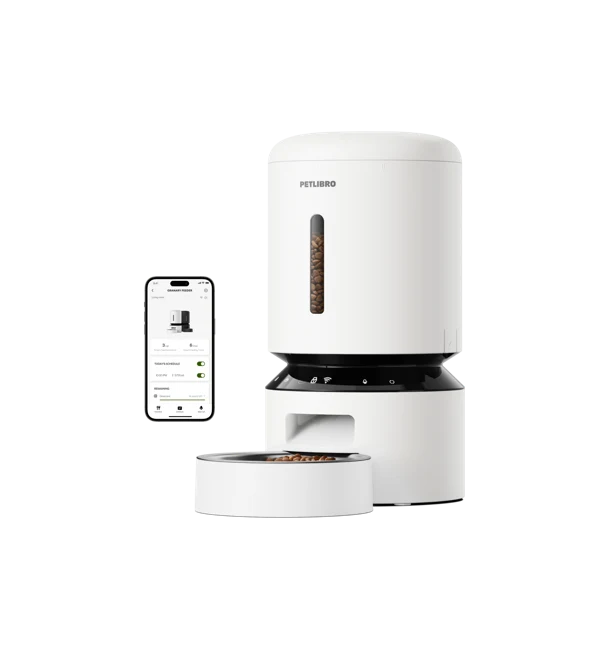
Explore this need in the finder →The PETLIBRO Granary WiFi PLAF103 is a useful comparison for a larger dry-food reserve with remote schedule control. This assessment follows the documented single-bowl package. Its 5 L hopper and dual-band Wi-Fi distinguish it from the smaller cordless Air Smart. Normal connected operation relies on the adapter; battery backup preserves meals while switching off Wi-Fi.
Choose it for remote control and hopper size
The exact manufacturer specification names PLAF103, a 5 L food tank and support for both 2.4 and 5 GHz Wi-Fi. That makes the available home network a simpler fit than a model limited to 2.4 GHz, provided the actual setup follows the instructions. The term 5 GHz refers to the router band, not cellular 5G service. PETLIBRO PLAF103 specifications and support.
Remote access is useful when a routine needs changing while someone is away from the house. It is not the same as proof that the animal has eaten the intended amount. Decide whether you need schedule control, a camera view or selective access before comparing products with similar Granary names.
Five liters does not define a refill interval
The larger reservoir may reduce how often it needs filling compared with a smaller hopper used for the same food and serving plan. It does not establish a universal number of days of feeding, because food density and the existing routine vary.
Keep the hopper clean and dry between food changes, follow the desiccant guidance and check the actual level. A low-food notification is helpful, but there still needs to be someone who can replenish the unit or investigate a blockage.
Food size and portion units need a real-world check
The maker specifies regular dry food from 2 to 15 mm in diameter and explicitly excludes wet food. A dry hopper is not a substitute for a tray that can present prepared moist meals.
The portion setting uses nominal volume, with the manufacturer's approximate gram estimate varying by food. During initial setup, compare what actually arrives with the amount your existing feeding plan calls for. A numerical portion setting should not be read as a universal weight or a nutritional recommendation.
The published daily event count has a conflict
The PLAF103 specification lists one to ten meal events, but the FAQ on the same current page describes a six-meal maximum. If a high event count is essential, confirm the exact model and software's supported limit with the manufacturer before choosing it for that routine.
This is separate from allowing different portion sizes at different times. A larger serving at one scheduled time cannot replace two distinct release times when timing itself matters. The unresolved limit therefore should not be used to promise a strict eight- or ten-event fit.
Do not confuse backup with cordless app use
The normal package uses a 5 V adapter. Three alkaline D cells, purchased separately, can continue stored meal schedules during an emergency, but PETLIBRO says Wi-Fi, the record button and reset are disabled when operating on those cells.
A mains outage can therefore leave the timer working while remote access stops. That suits a schedule-continuity requirement, provided the batteries have been installed and checked. It does not meet a routine no-outlet requirement for app control; the rechargeable Air Smart PLAF108 is the more relevant type to investigate for that need.
Keep the chosen bowl configuration explicit
The manufacturer page presents single- and dual-bowl packages with different contents. Check whether your chosen offer includes the correct tray and splitter. A photograph of two bowls on a shared page does not establish what arrives in every PLAF103 box.
A splitter is also not individual pet recognition. If one animal takes the other's meal, an identity-controlled feeder addresses that access problem more directly than the size of this hopper or the number of displayed bowls.
Choose PLAF103 when a mains-powered 5 L dry-food routine and remote plan changes are the priorities. Confirm the disputed event limit and exact bowl package when they matter. Its value is that particular combination of storage and connected control, with clear boundaries around battery mode.
Key details at a glance
| Dry-food compatibility | Yes |
|---|---|
| Wet-food compatibility | No |
| Timed meal releases | Yes |
| App plans or food targets | Yes |
| Routine battery operation | No |
| Backup for stored meal schedules | Yes |
| Separate simultaneous feeding positions | No |
| Dry-food hopper volume | 5 L |
| Documented minimum regular-kibble diameter | 2 mm |
| Documented upper regular-kibble boundary | 15 mm |
Use the exact model’s instructions for operating limits, supplied equipment and version differences.
Sources for this assessment
Compare the options for your routine.
Bring together the food, feeding function, controls and power that matter to you.