
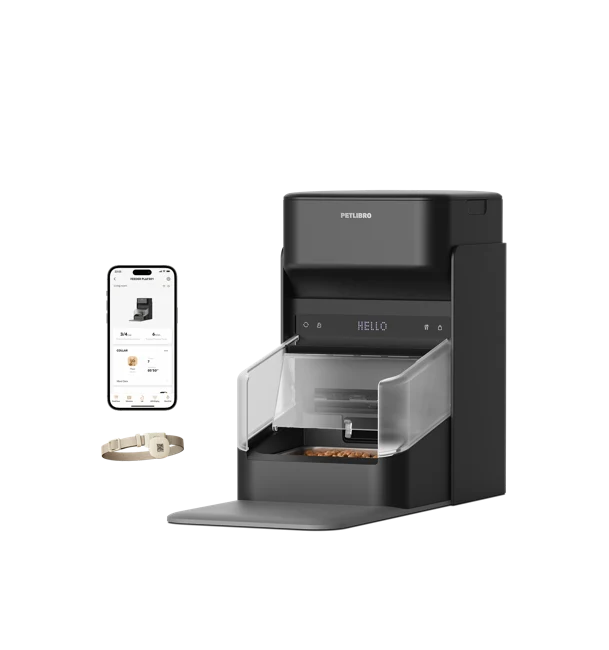
Your needs, this model
Does it fit your priorities?
Can it use the implanted microchip my cat already has?
No. The exact PLAF301 requires its dedicated collar tag and attached reader mat; implanted microchips and other brands' RFID tags are explicitly unsupported.
Explore this need in the finder →Can one feeder identify both cats and serve different allowances?
One PLAF301 pairs to one tag. A multi-unit package supplies separate stations, rather than expanding one feeder's tag count; follow the maker's spacing and setup instructions for several units.
Explore this need in the finder →Can it combine protected access with ten timed dry-food events?
The maker documents selective collar-tag access and up to ten scheduled meal events. Check compatible regular kibble and maintain mains power for remote app use; backup preserves schedules but disables Wi-Fi.
Explore this need in the finder →The PETLIBRO One PLAF301 is most relevant when the problem is another pet taking a cat's dry food. It combines scheduled portions with a lid unlocked by a dedicated collar tag. That makes it a different kind of choice from an open-bowl timer, but it also adds a collar, reader mat and one-feeder-per-tag setup to the routine.
Selective access is the reason to consider it
The reader verifies the compatible tag before allowing the lid to unlock. PETLIBRO explicitly says the system does not read implanted microchips or other brands' RFID tags. One feeder synchronizes with one collar tag, so an existing microchip in your cat is not enough to operate it. PETLIBRO One PLAF301 specifications and FAQ.
Decide whether wearing the supplied style of collar and approaching the reader fits the particular cat. Watch the first interactions and follow the introduction instructions. The feature is useful only when the correct animal can consistently use the access arrangement.
This is also why camera identification and selective feeding should not share a label. A camera can record who appears at a bowl without controlling the lid. The One's defining job is access, not merely an observation in a feeding log.
The reader mat is an essential component
The supplied mat is the RFID reader, not a decorative spill mat. PETLIBRO says recognition will fail if it is not properly attached and recommends checking the connection daily. Allow for its place in the complete floor arrangement when choosing where the feeder will stand.
For several cats needing separate portions, the manufacturer describes separate One units and spacing between them. Its guidance specifies at least ten inches between feeders to reduce interference. A two- or three-unit pack changes the number of complete stations, not how many tags one feeder can recognize.
Scheduling and protected access are separate benefits
The model has a 3 L dry-food hopper and app-managed schedules of up to ten meal events a day. You can therefore consider both a timer requirement and selective-access requirement together. A protected bowl without a timer would solve only part of that job.
Check the regular kibble against the documented 2–15 mm diameter range. The manufacturer excludes wet food. Do not choose the One for canned meals because its lid looks enclosed; an enclosed bowl does not establish cooling or compatibility with moist food in the dispensing path.
As with any portion dispenser, check actual delivery with the intended food. The access feature does not determine the correct diet or turn a nominal portion setting into a universal food weight.
Normal power and outage behavior need separate checks
The exact specification supports both 2.4 and 5 GHz Wi-Fi. In normal use, keep the supplied power arrangement connected as directed. Three alkaline D cells, bought separately, are an emergency option; PETLIBRO warns against using them as the sole everyday power source.
The maker says stored schedules continue on backup while Wi-Fi and reset functions are disabled. Remote app access should therefore not be part of the outage promise. If continued identification or lid behavior during an outage is essential to a particular separation plan, check the actual operating instructions for that mode rather than infer it solely from continued dispensing.
What to confirm before ordering
Check the package includes the correct collar/tag, reader, bowl and lid components. The tag is described as splashproof rather than submersible, and it does not require charging. Those details matter more than whether the listing uses a broad smart-feeder label.
Choose PLAF301 when one identified cat needs its own scheduled dry-food station and the collar-reader arrangement suits the home. Choose an implanted-microchip model when a collar is unacceptable, a wet-food-compatible protected bowl for prepared moist meals, or a simpler open feeder when pet-specific access is unnecessary. The One is worthwhile for its particular access system, not as an automatic upgrade for every feeding routine.
Key details at a glance
| Dry-food compatibility | Yes |
|---|---|
| Wet-food compatibility | No |
| Timed meal releases | Yes |
| Pet-specific access control | Yes |
| Implanted-microchip access | No |
| Compatible collar-tag access | Yes |
| App plans or food targets | Yes |
| Routine battery operation | No |
| Backup for stored meal schedules | Yes |
| Separate simultaneous feeding positions | No |
| Maximum documented scheduled meals per day | 10 |
| Dry-food hopper volume | 3 L |
| Documented minimum regular-kibble diameter | 2 mm |
| Documented upper regular-kibble boundary | 15 mm |
Use the exact model’s instructions for operating limits, supplied equipment and version differences.
Sources for this assessment
Compare the options for your routine.
Bring together the food, feeding function, controls and power that matter to you.