
Your needs, this model
Does it fit your priorities?
Can it open for my cat’s implanted microchip without an app?
The ordinary SureFeed supports compatible identification microchips and local pet learning. Use the maker’s chip checker. Its four alkaline C cells are the normal supply; no app is required for the documented access routine.
Explore this need in the finder →Will it release a measured lunch at a programmed time?
No. You fill its bowl yourself and the registered pet controls access. It has no scheduled portion-release function, so it cannot satisfy a timed-meal essential.
Explore this need in the finder →Does the split bowl provide two independent cat feeding positions?
No. It is one bowl divided into food sections within one access station. Registered pets share authorization to that station; the sections do not allocate separate diets or portions to each animal.
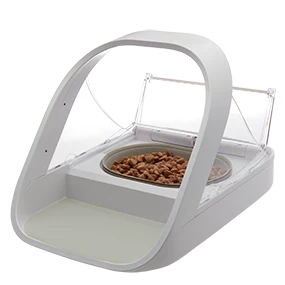
Explore this need in the finder →The SureFeed Microchip Pet Feeder MPF001 is a protected food bowl for a registered animal, rather than a machine that dispenses meals at programmed times. It is a strong type of solution to consider when another pet steals food, especially if you want implanted-microchip access and normal battery operation without an app. You still fill the bowl and manage the food yourself.
Choose it for access, not a feeding clock
The official US product page describes the lid opening when an authorized pet approaches. The original operating booklet explains the same sequence: the reader checks the pet at the front hoop, permits access and closes the lid after the animal leaves.
That mechanism protects a meal already placed in the bowl. It does not meter kibble from a reservoir or rotate to a future timed compartment. If your question is “who can eat this food?”, it addresses the right job. If the requirement is “release a measured lunch at noon”, a timed feeder is a different tool. Requiring both functions should not silently turn this bowl into a scheduled dispenser.
Register the right pet, not the whole household by default
Sure Petcare documents compatibility with common identification microchips and its compatible RFID collar tag, with one tag included. Use the manufacturer's compatibility checker for the actual implanted chip before buying. A pet wearing a different brand of tag is not automatically covered by the supported-tag statement.
The feeder can remember up to 32 registered identities. That number is permission memory, not 32 separate bowls or individualized portions. If both cats are registered to the same feeder, both are being allowed to reach that food. For separate diets, decide which animal should be authorized at each station rather than treating a high identity count as automatic meal separation.
Observe the physical arrangement too. The maker offers a separate rear cover for persistent food stealing. A recognized front approach does not establish that every household interaction around an open bowl is prevented. Arrange clear access and watch both animals during the initial meals.
Battery operation keeps the basic setup local
The booklet specifies four 1.5V alkaline C cells for routine use and says the product is not designed for rechargeable batteries. A warning light indicates low battery condition. This is its normal operating supply, rather than a mains-powered schedule with emergency backup.
The main controls learn a pet, open or close the lid, and run training. There is no meal timetable to program and no app required for those documented functions. This suits a protected-bowl arrangement away from a nearby outlet. It does not provide remote viewing or an online record of how much the cat ate.
Wet and dry food remain your responsibility
The maker permits both food types and supplies a single bowl and a split bowl. The split bowl offers sections for different foods within the same feeding station. It does not create two independent pet-specific feeding places.
The bowl's upper seal works with the closed lid to help keep flies away and retain moisture. That is a closure feature, not a documented active refrigerator. Follow the food label and handling guidance for whatever you load. The FDA advises promptly refrigerating or discarding unused canned or pouched food; a lid should not be used to invent a new unattended holding period.
Plan training and cleaning before relying on it
The training routine starts with the lid remaining open, then introduces progressively more movement. Let the animal become comfortable at each stage rather than forcing a deadline. During the open training stage, the food is not protected in the same way as normal operation, so supervise the other pets accordingly.
The original booklet recommends hand washing the supplied bowls and mat to preserve their seals, and hand washing the removable lid. It excludes immersing the whole feeder or putting it in a dishwasher. Clean the sensing area and remove food debris that could obstruct the lid before checking normal operation again.
Our decision
Choose MPF001 for a locally operated, battery-powered protected bowl with documented microchip or compatible-tag recognition. Choose a different type for timed releases, a bulk hopper or powered cooling. If access protection is right but meal-weight records and app-supported setup would help, compare the separate Microchip Pet Feeder Connect, including its Hub requirements.
Key details at a glance
| Dry-food compatibility | Yes |
|---|---|
| Wet-food compatibility | Yes |
| Timed meal releases | No |
| Pet-specific access control | Yes |
| Implanted-microchip access | Yes |
| Compatible collar-tag access | Yes |
| App plans or food targets | No |
| Local meal-schedule programming | No |
| Local pet-access setup | Yes |
| Routine battery operation | Yes |
| Separate simultaneous feeding positions | No |
| Separate food hoppers | No |
| Maximum documented scheduled meals per day | 0 |
Use the exact model’s instructions for operating limits, supplied equipment and version differences.
Sources for this assessment
Compare the options for your routine.
Bring together the food, feeding function, controls and power that matter to you.