
Your needs, this model
Does it fit your priorities?
Can two cats get dry food in two bowls without app setup?
FT50D includes two simultaneous bowls and local schedule controls. Both bowls share one hopper and splitter; the feeder does not decide which cat receives which food.
Explore this need in the finder →Does FT50D offer twenty scheduled meal times?
No. Twenty is the maximum portion-unit setting per release. The exact feeder supports up to six scheduled daily meal times.
Explore this need in the finder →Is regular 10 mm kibble within its documented range?
The maker gives an ideal 2–12 mm interval, while the original guide requires less than 12 mm. Ten mm lies inside that narrower boundary; test its actual shape and output in both bowls.
Explore this need in the finder →Two bowl positions from one locally timed feeder
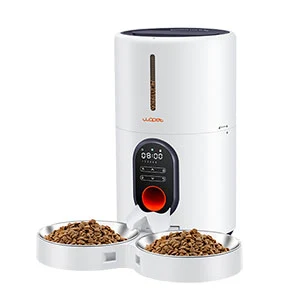
The WOpet Barn FT50D is for an owner who wants to set a dry-food timetable on the feeder and present food in two bowls at the same time. It combines a four-liter reservoir, a splitter and two stainless-steel bowls. That can be useful when two cats already eat alongside each other without one controlling both positions.
It is not a system for storing separate diets or recognizing which cat should eat each meal. The food begins in one reservoir and is divided into two open feeding positions. Decide whether that arrangement fits the cats' existing behavior before selecting two bowls as an essential feature. Two places to eat do not guarantee two animals receive equal amounts.
The FT50D timetable is programmed at the device
The original quick-start sheet walks through the local clock, meal time and portion settings. It uses a 24-hour clock, with up to six scheduled releases in a day. Set the current time first, then check every active meal slot and confirm the stored amount. The display lock is useful for avoiding accidental button changes between adjustments.
This D version permits up to twenty portion units per meal. That is a real difference from the single-bowl FT50's eight-unit setting; do not substitute one model's range for the other. It is still a maximum of six scheduled meal times, rather than twenty meals or twenty independently controlled servings for each cat.
The original sheet describes a portion as approximately 20 ml and about 12 grams. These are estimates for the dispensing mechanism, not a scale measurement of your own food. Observe output in both bowls with the intended kibble and check the actual amount each cat can reach. A splitter's geometry and two cats' behavior should not be replaced with an assumed fifty-fifty intake.
Use the stricter food boundary in the original guide
The product page gives an ideal regular-kibble range of 2–12 mm and says dry food only. Its exact quick-start troubleshooting sheet is more restrictive at the top end, saying the diameter must be less than 12 mm. This assessment therefore does not treat exactly 12 mm as a confirmed fit.
A pellet within the documented interval still needs a practical observed check for shape and flow. This feeder is not for canned wet food, and a desiccant bag does not add refrigeration. Four liters describes the reservoir; it does not establish a safe or suitable unattended interval, especially when the same supply is feeding two animals.
No app requirement, with a documented outage arrangement
The maker explicitly marks app control as No for FT50D. Its local programming makes it relevant if you want to set the full plan without Wi-Fi or a phone account. The recorded meal call can be up to ten seconds, but that is a sound cue, not remote communication or proof that a pet has eaten.
The box lists a 5V, 1A adapter and USB-C cable. Three D alkaline batteries, purchased separately, are described as backup for outages. Install and check them if maintaining the stored timetable during a power interruption is important. The manufacturer presents DC operation with backup cells; that is not the same documented use case as a feeder intended to live indefinitely away from an outlet.
Locks and two bowls solve limited problems
The lid lock concerns access to the stored food. It does not close a served bowl against the wrong animal. Likewise, the screen lock protects programming rather than identifying pets. If one cat needs a diet the other must not reach, a recognized-pet access mechanism is the more important requirement than the number of bowls.
Watch both cats during initial use. If one moves between bowls or guards the dispenser, consider separating feeding locations rather than assuming the second bowl will end competition. This is a practical fit question about the setup, not a claim that a particular pet will accept or reject the FT50D.
Cleaning and the final shortlist
The food container and bowls are removable for cleaning. Follow the supplied directions for the feeding path and keep the powered base dry; do not assume that every removable part belongs in a dishwasher. Reassemble the food path carefully and make observed manual releases before returning to unattended timing.
Choose FT50D for compatible dry food, two simultaneous bowl positions and local scheduling of up to six meals. Choose FT50 for one bowl and its different portion range, a connected feeder for remote timetable edits, or a truly selective-access design when the central problem is food stealing. The D suffix earns its place for the reviewed splitter-and-two-bowl configuration, not for pet-specific meal control.
Sources: WOpet FT50D exact product specification and FAQ and original FT50D quick-start guide.
Key details at a glance
| Dry-food compatibility | Yes |
|---|---|
| Wet-food compatibility | No |
| Timed meal releases | Yes |
| App plans or food targets | No |
| Local meal-schedule programming | Yes |
| Routine battery operation | No |
| Backup for stored meal schedules | Yes |
| Separate simultaneous feeding positions | Yes |
| Separate food hoppers | No |
| Maximum documented scheduled meals per day | 6 |
| Dry-food hopper volume | 4 L |
| Documented minimum regular-kibble diameter | 2 mm |
| Documented upper regular-kibble boundary | Under 12 mm |
Use the exact model’s instructions for operating limits, supplied equipment and version differences.
Sources for this assessment
Compare the options for your routine.
Bring together the food, feeding function, controls and power that matter to you.