
Your needs, this model
Does it fit your priorities?
Which Patrol supports more than six scheduled daily releases?
The exact F07 Pro supports up to fifteen daily meals, with one to fifty portion units at each release. That is timetable flexibility, not a recommendation to use every meal slot.
Explore this need in the finder →Can I adjust the app plan while it runs on its outage batteries?
No. WOpet says Wi-Fi and app operation require the adapter. Three D backup batteries maintain the stored schedule, not remote control.
Explore this need in the finder →Will this Pro suit regular 13 mm kibble and a 2.4 GHz network?
Its documented regular pellet interval is 5–15 mm and its app uses 2.4 GHz. Confirm shape and actual dispensing with your food before relying on the timetable.
Explore this need in the finder →A larger hopper with a more flexible daily timetable
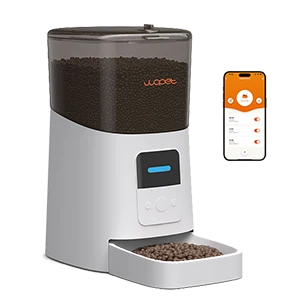
The WOpet Patrol F07 Pro is aimed at a dry-food routine that needs app scheduling and room for more than a few daily releases. Its useful distinctions are a six-liter hopper and support for up to fifteen scheduled meals a day. That makes it a more appropriate model to investigate for a finely divided existing feeding plan than a six-meal local timer, provided the food and network requirements also fit.
Keep the Pro suffix when comparing offers. WOpet's page includes separate specifications for an older F07 as well as this F07 Pro. A shared Patrol name is not proof of the same body, controls or dimensions. This assessment concerns the Pro configuration identified in the current model-specific section.
Fifteen meals does not mean fifteen different diets
The feeder dispenses from one hopper into one feeding station. The schedule can break a daily routine into as many as fifteen timed releases, while each release can contain one to fifty portion units. Those are two different controls: the number of releases sets the timetable, and the portion count sets the amount for each release.
WOpet describes each portion as approximately five grams. Do not interpret that number as a calibrated weighing result for your kibble. Check the dispensed amount with the actual food and chosen setting before relying on it. More scheduling slots also do not determine the right daily feeding frequency; use the plan appropriate for the cat rather than filling every slot because it is available.
The six-liter capacity is useful when refill frequency is inconvenient, but it is still a storage volume. It does not establish a guaranteed number of unattended days. Keep enough food for the intended schedule and check the hopper, outlet and bowl rather than treating a large container as the only reliability requirement.
The food range is a real selection boundary
WOpet specifies food pellets in the 5–15 mm range for this exact Pro. That gives the finder a documented interval rather than a guessed maximum inherited from a neighboring product. Compare your regular kibble with both ends of the range. Irregular pieces and different shapes still deserve an observed dispensing check; a nominal diameter does not prove every formulation flows equally well.
This is a dry-food hopper arrangement. It is not a wet-food cooling system or a way to keep two diets separated. A sealed lid and desiccant help manage stored dry food, but they do not make the open bowl available only to the intended cat. For food stealing, look at documented pet-recognition access rather than another scheduling setting.
Connected control needs the right power and network
Feeding plans are managed through the WOpet Life app on a compatible phone, using 2.4 GHz Wi-Fi. The exact Pro reference does not support a 5 GHz-only requirement. Place it where the intended network reaches the feeding location, not merely where pairing happens to work beside the router.
The package lists a 5V, 1A adapter and a USB-C cable. That adapter-powered mode is required for Wi-Fi and app operation. It lets you adjust the plan remotely and receive supported notifications, including low-food information. A message that dispensing occurred still should not be read as proof that a particular cat ate the food.
Backup preserves feeding, not the connected experience
Three separately purchased D batteries can maintain the stored feeding schedule if mains power fails. WOpet explicitly separates this backup function from Wi-Fi and app operation, which require the adapter. This is the distinction to keep in mind when choosing the outage-feeding answer in the finder: the documented benefit is continued scheduled dispensing.
It is not a verified promise that you can make remote changes while the feeder runs only on batteries. The battery arrangement is presented as backup rather than routine untethered operation. Check the cells and the saved plan before an absence, and make sure someone can check the cat and equipment if connectivity or dispensing becomes uncertain.
Controls, cleanup and the final choice
A recorded meal call can be up to ten seconds. It may be useful as a familiar cue, but it is not evidence that a cat will accept the device or stop competing for food. The locking lid and quick-release parts are more practical details: they affect refilling and access to the feeding path. Keep the electronic base dry and follow the supplied cleaning instructions for removable parts.
Choose the F07 Pro when compatible dry food, a six-liter single hopper, remote scheduling and up to fifteen daily releases match the actual routine. Compare a local timer for app-free programming, a dual-bowl configuration for two simultaneous feeding positions, or a selective-access feeder when controlling who reaches the meal matters more than the timetable.
Source: WOpet F07 Pro model-specific specifications, app and backup-power notes.
Key details at a glance
| Dry-food compatibility | Yes |
|---|---|
| Timed meal releases | Yes |
| App plans or food targets | Yes |
| Routine battery operation | No |
| Backup for stored meal schedules | Yes |
| Separate simultaneous feeding positions | No |
| Separate food hoppers | No |
| Maximum documented scheduled meals per day | 15 |
| Dry-food hopper volume | 6 L |
| Documented minimum regular-kibble diameter | 5 mm |
| Documented upper regular-kibble boundary | 15 mm |
Use the exact model’s instructions for operating limits, supplied equipment and version differences.
Sources for this assessment
Compare the options for your routine.
Bring together the food, feeding function, controls and power that matter to you.