
On this page
How the C3000 fits a dry-meal schedule
The C3000 suits a dry-food routine programmed on the feeder without an outlet: its manual documents three independent appointments and a 16 mm kibble maximum. It does not provide selective access, and Frequent Feed is not extra scheduled meals.
Explore the needs this model fits
Your needs, this model
Does it fit your priorities?
Can I choose four different meal times?
The C3000 has three independent daily appointments. Its separate Frequent Feed mode spreads food across a time window; that is not a fourth chosen clock time.
Explore this need in the finder →Can it run normally where there is no outlet?
Yes. Four C cells run the local timer and dispensing mechanism; this is normal battery operation rather than emergency-only backup.
Explore this need in the finder →Is larger dry kibble a possible fit?
The maker gives a maximum of 16 mm for dry food. Check shape and real dispensing with your food; this upper limit is not a measured jam-free guarantee.
Explore this need in the finder →The Cat Mate C3000 suits a dry-food routine with up to three individually timed meals and a feeder you program locally. Normal battery operation makes it useful away from an outlet. Its main tradeoff is a traditional button-and-display workflow instead of remote app control, video or pet recognition.
A hopper for a repeating dry-food routine
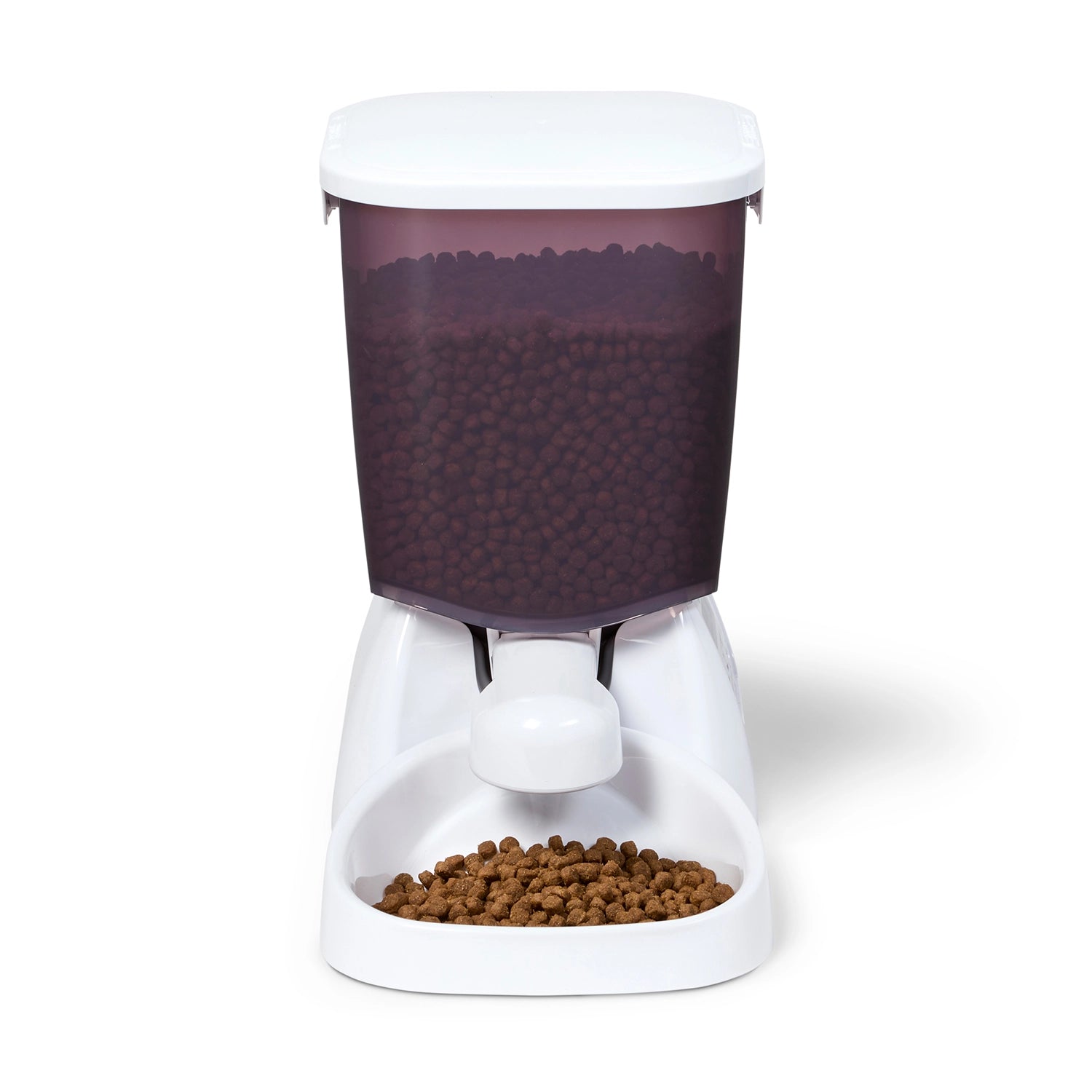
The C3000 stores dry food above a dispensing mechanism, rather than exposing successive prefilled compartments. That changes the refill task: instead of preparing each future meal separately, you check the supply and establish how much your particular food dispenses at the chosen settings.
The US product page specifies a reservoir holding up to 6.5 lb of dry food. That is a food-mass description, not a documented litre measurement. A heavier or denser kibble should not be used to claim a larger reservoir. Consider whether you can comfortably lift and clean the hopper rather than buying only on its maximum food-weight headline.
Three set times, with a different frequent-feed mode
The C3000 support FAQ confirms three independently set meal times. Each can have its own portion setting. That is a good match when breakfast, lunch and dinner cover the intended schedule; it does not meet a request for four separately chosen clock times.
The manual also describes Frequent Feed, which distributes a chosen amount over a period. Treat it as a separate operating pattern. It is not evidence that you can add arbitrary independent meal appointments beyond the three standard times. Decide whether you need particular appointments or food spread across a window before comparing schedule counts.
Measure the result with the food you use
The maker documents dry kibble up to 16 mm. That limit is useful for screening out clearly oversized food, but does not guarantee that every irregular piece will flow in the same way. The instructions require priming the outlet so that food reaches the dispensing path before normal operation.
A sensible first setup includes weighing several dispensed portions and observing a full day's chosen routine. Repeat that check after a food change. Numbers in the portion menu describe the mechanism's settings; they do not establish the correct daily allowance or prove that an animal ate everything in the bowl.
Battery power makes location easier
Four C cells provide ordinary operating power. There is no Wi-Fi pairing step or need to locate the feeder near a socket. The manual recommends alkaline cells for the low-battery indication to work correctly. Keep a note of changes and inspect the warning rather than treating the maker's approximate battery-life figure as a service deadline.
The tradeoff is that the feeder's display is where you inspect and change the routine. If your aim is to adjust dinner from work, choose an app model such as the Catit PIXI Smart. If local operation and independence from a household network matter more, the C3000's simpler control arrangement can be the more relevant feature.
Cleaning and access determine the practical fit
The hopper and food-path components detach for cleaning; the electronic base stays out of water. Dry cleaned parts before refilling, and check that the outlet is primed again. Keep enough space around the appliance to remove the reservoir without spilling food into the controls.
The exposed bowl does not identify pets. A larger food supply cannot keep a second cat from eating the first one's meal. Choose the C3000 for a checked, locally programmed dry-food schedule; choose a selective-access feeder when the difficult part is deciding who can reach the food. Those are different problems even when both products are sold as automatic feeders.
Key specifications
Key details at a glance
| Dry-food compatibility | Yes |
|---|---|
| Wet-food compatibility | No |
| Timed meal releases | Yes |
| Pet-specific access control | No |
| Powered cooling | No |
| Ice-pack arrangement | No |
More specifications and setup details
| App plans or food targets | No |
|---|---|
| Local meal-schedule programming | Yes |
| Routine battery operation | Yes |
| Separate simultaneous feeding positions | No |
| Separate food hoppers | No |
| Maximum documented scheduled meals per day | 3 |
| Documented upper regular-kibble boundary | 16 mm |
Use the exact model’s instructions for operating limits, supplied equipment and version differences.
Sources for this review
Sources for this assessment
Compare the options for your routine.
Bring together the food, feeding function, controls and power that matter to you.
Your needs, this model
Local meal programming for a feeder without an outlet
Choose it when: The exact manual documents local programming and battery-primary operation, so the schedule does not rely on an app or outlet.
Local meal programming for a feeder without an outlet →Feeders programmed on the device, without an app
Choose it when: Its original manual describes local clock and meal-time programming and four C cells for normal operation, so it suits a dry routine that should not depend on an app or outlet.
Feeders programmed on the device, without an app →Feeders for regular dry kibble measuring 12 mm
Choose it when: The exact manual allows dry kibble up to 16 mm inclusive, so 12 mm is below its documented upper bound.
Feeders for regular dry kibble measuring 12 mm →