
On this page
Your needs, this model
Does it fit your priorities?
Can I program eight meals without an app?
Yes. FlexFeed has a full local time-and-portion workflow for up to eight daily meals; the timetable repeats daily.
Explore this need in the finder →Does it support dry-food feeding during a power cut?
The maker documents optional three-D-cell backup for feeding during outages. Install and check usable batteries; they are not supplied in the box list.
Explore this need in the finder →Can I refill it with semi-moist or canned food?
No. The exact assembly instructions exclude moist, semi-moist, canned and wet food. Compare a compatible prepared-meal tray for wet feeding.
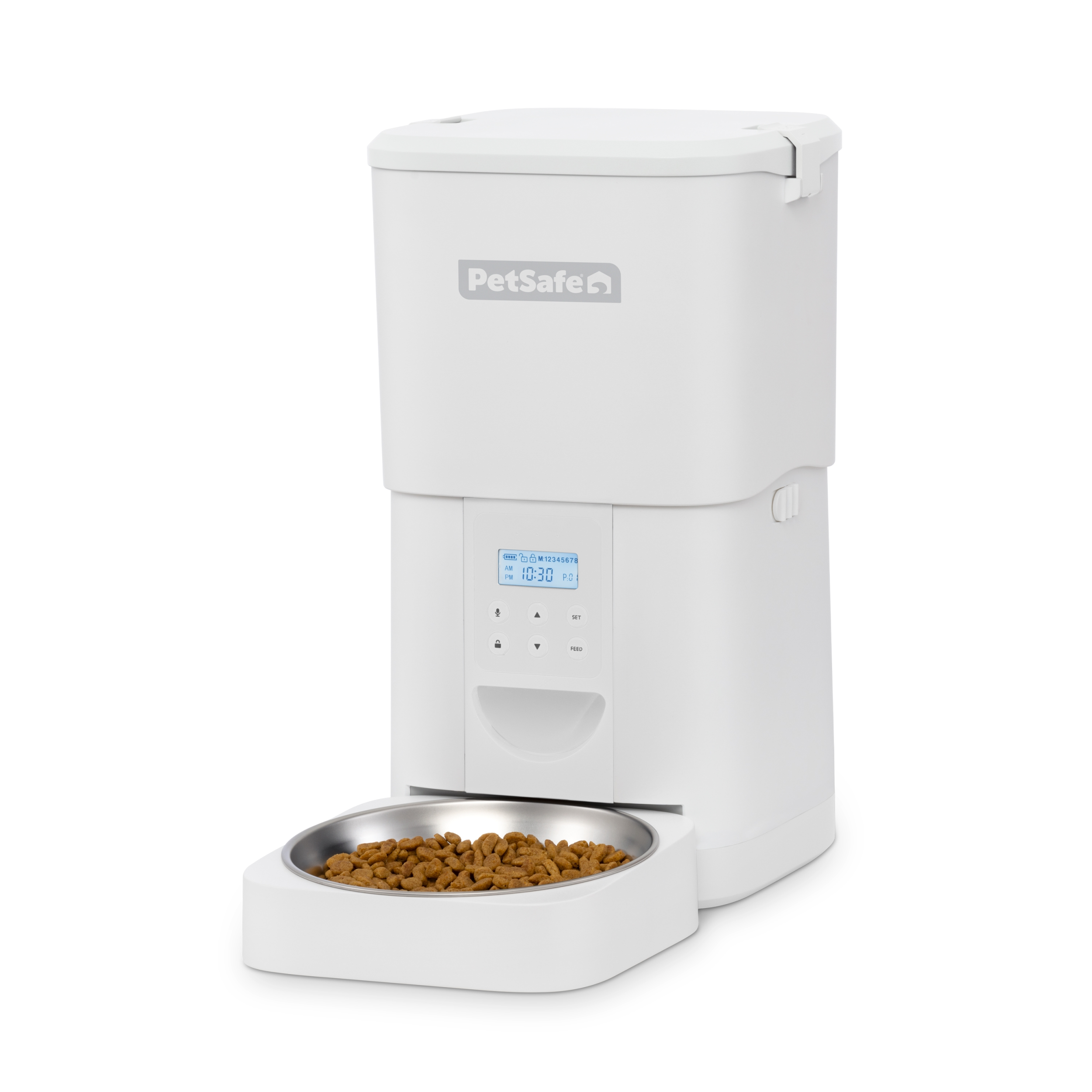
Explore this need in the finder →PetSafe FlexFeed PFD00-18090 is a useful choice for several daily dry-food meals without an app. It combines a locally programmed schedule, an 8-cup reservoir and backup batteries. Choose it when a straightforward repeating routine matters more than watching the bowl remotely or identifying individual cats.
A smaller hopper can fit a focused routine
The FlexFeed specification gives an 8-cup, 2 L reservoir and up to eight timed meals daily. That provides a meaningful distinction from both a single delayed bowl and a much larger reservoir. Decide how often you want to refill and inspect the feeder, rather than assuming that maximum stored food is always better.
Each meal has a portion setting. A smaller release repeated several times may suit an established feeding routine, but the feeder cannot decide the correct allowance. Count the total programmed food for the day, including any manual releases, and check several outputs using the actual kibble. Keep those notes when changing the routine.
Local programming means a real timetable
PetSafe's programming instructions describe setting the meal count, time and portion on the appliance. This is a complete no-app workflow, rather than merely a button that dispenses one extra serving. The times repeat daily.
That makes FlexFeed relevant if you want the feeder to work independently of a household network. The tradeoff is being present at the controls to change the plan. If you frequently need to move a meal while away, compare an app-managed model instead. A prerecorded meal call can attract attention, but is not a two-way conversation or evidence that the cat has eaten.
Food compatibility includes the dispensing path
The assembly guide specifies dry food and excludes canned, moist and semi-moist food. It recommends approximately 5–12 mm kibble. A wet-food choice in the finder therefore leads elsewhere, even if a retailer's picture shows a general-purpose food bowl.
PetSafe also requires priming the feeder before its first programmed meal and after refilling. That is a practical ownership detail: food in the reservoir does not necessarily mean the outlet is ready to deliver a full portion. Check the initial releases with the intended food before relying on the schedule.
Backup belongs in the setup
The supplied wall adaptor runs the feeder normally. Three optional D cells provide backup during an outage. Install and inspect them if outage resilience is one of your buying requirements; a battery compartment with no usable cells provides no reassurance.
Backup support does not turn this into a remotely monitored appliance. Watch a trial meal with your normal settings and verify the food reaching the bowl. The useful outcome is a checked feeding routine, not simply a lit screen.
Clean the bowl and hopper differently
The stainless bowl is dishwasher-safe. PetSafe's cleaning instructions call for hand-washing the hopper, lid, chute cover and tray, while wiping the electronic base. This distinction matters if your preference is putting the entire removable food path into a dishwasher.
The Food-Saver Pouch has its own lid compartment and replacement schedule. Remove it for cleaning, dry the food path thoroughly and recheck priming after assembly. Moisture-control accessories do not remove the need to inspect the food.
Who should compare something else?
Choose the C3000 if ordinary battery operation without an outlet is the decisive requirement. Choose a prepared tray for compatible wet meals. Choose selective access for food stealing. FlexFeed's open dish is shared access, regardless of how many pets a listing says the household can contain.
FlexFeed is strongest when your answers are dry food, scheduled meals, local setup and optional outage backup. Those requirements describe a coherent job that it can document, without paying attention to camera or recognition features that this routine does not require.
Key specifications
Key details at a glance
| Dry-food compatibility | Yes |
|---|---|
| Wet-food compatibility | No |
| Timed meal releases | Yes |
| Pet-specific access control | No |
| Powered cooling | No |
| Ice-pack arrangement | No |
More specifications and setup details
| App plans or food targets | No |
|---|---|
| Local meal-schedule programming | Yes |
| Backup for stored meal schedules | Yes |
| Separate simultaneous feeding positions | No |
| Separate food hoppers | No |
| Maximum documented scheduled meals per day | 8 |
| Dry-food hopper volume | 2 L |
| Documented minimum regular-kibble diameter | 5 mm |
| Documented upper regular-kibble boundary | 12 mm |
Use the exact model’s instructions for operating limits, supplied equipment and version differences.
Sources for this review
Sources for this assessment
Compare the options for your routine.
Bring together the food, feeding function, controls and power that matter to you.