
On this page
Your needs, this model
Does it fit your priorities?
Can I rely on ten daily appointments for every HV10DP?
The product says ten but the exact linked manual says six. Six is supported by both; more than six is not treated as confirmed for this model.
Explore this need in the finder →Does it fit a camera plus two simultaneous bowls?
Yes. HV10DP explicitly combines an integrated camera and a dual-bowl layout in normal powered operation.
Explore this need in the finder →Will it let only one named cat reach each bowl?
No physical identity-access barrier is documented. Both bowls are open positions using the same food supply.
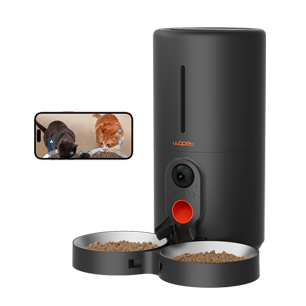
Explore this need in the finder →WOpet Heritage View HV10DP combines a camera and two open bowls around a 6 L dry-food reservoir. It is worth comparing when simultaneous feeding positions and remote observation are both useful. It does not identify which cat may eat, and the manual's six-meal limit differs from the current product-page ten-meal claim.
Two bowls are the first practical difference
The HV10DP product page lists two stainless bowls. Its HV10/HV10DP manual shows the dual-bowl assembly. That provides a documented second feeding position rather than a vague claim that a household can contain several pets.
The positions share one food supply. If two animals need different recipes, the reservoir does not separate them. If one cat visits both sides, the camera may help you observe the behavior but will not physically stop it. Require separate hoppers or selective access when those are the real needs.
Use the supported schedule count carefully
The current HV10DP page advertises ten daily meals, while the linked exact-model manual specifies one to six. Both establish a repeating app-managed routine, but they do not establish the same maximum. Six appointments are within both descriptions; more than six is not treated as confirmed for a strict match here.
Check the current unit and app before choosing it for a higher-frequency requirement. This is more useful than either assuming all versions have ten appointments or excluding the feeder from every meal-count comparison because its maximum differs between documents.
The camera observes the feeding area
The maker describes video, night vision, adjustable vertical positioning and two-way audio. Consider where the feeder will sit, which parts of the bowls you need to see and whether another object will block the view. Advertising a wide angle is not evidence that a particular home layout will be covered.
The app offers camera privacy controls, and recordings involve the specified storage arrangement. Decide whether you need a live check or a history of visits, then confirm the exact package and current service requirements. Do not assume the existence of a camera proves every record will be retained indefinitely.
Use the manual's dry-food boundary
The manual specifies dry kibble between 2 and 12 mm. Check actual dimensions and shapes before relying on the dispenser. Wet food needs another system. Measure the amounts reaching both bowls with the intended food instead of treating portion settings as a guaranteed split between cats.
The reservoir, food path and bowls require separate cleaning attention. The manual allows washing the stainless bowls, while the electronic base stays out of water. Rebuild the splitter and bowls carefully and observe the next release on both sides.
Backup cells do not keep the full connected workflow
The product describes three D alkaline cells to support feeding during a power interruption. The manual explicitly limits app operations on cells and describes them as backup only. Normal connected use therefore remains adapter-powered.
Install and check the cells if backup feeding matters. A power interruption is also a reason to verify the stored plan and the food arriving in the bowls. Do not select HV10DP for normal camera use where no outlet is available.
Choose the configuration around the household
HV10DP fits dry-food app scheduling, two simultaneous open positions and camera observation. Compare HV10P when one bowl is enough, or Vision Duo when its bowl-weighing arrangement is useful. Choose protected access when another pet must be kept away. Each comparison follows a real feeding requirement rather than a similar-looking camera.
Key specifications
Key details at a glance
| Dry-food compatibility | Yes |
|---|---|
| Wet-food compatibility | No |
| Timed meal releases | Yes |
| Pet-specific access control | No |
| Powered cooling | No |
| Ice-pack arrangement | No |
More specifications and setup details
| App plans or food targets | Yes |
|---|---|
| Integrated camera | Yes |
| Local meal-schedule programming | No |
| Routine battery operation | No |
| Backup for stored meal schedules | Yes |
| Separate simultaneous feeding positions | Yes |
| Separate food hoppers | No |
| Supported daily meals where the stated maximum differs | 6 |
| Dry-food hopper volume | 6 L |
| Documented minimum regular-kibble diameter | 2 mm |
| Documented upper regular-kibble boundary | 12 mm |
Use the exact model’s instructions for operating limits, supplied equipment and version differences.
Sources for this review
Sources for this assessment
Compare the options for your routine.
Bring together the food, feeding function, controls and power that matter to you.