
On this page
Your needs, this model
Does it fit your priorities?
Can I set six meals without Wi-Fi?
Yes. CL11 has local clock-and-meal controls and the exact manual documents six daily appointments.
Explore this need in the finder →Is its hopper4Lor 5 L?
The exact CL11 manual and product specification table say 4 L; the contradictory 5 L marketing sentence is not used for matching.
Explore this need in the finder →Does the display stay lit on cells?
The exact manual says the display goes off to save battery power. A dark panel in that mode is not by itself proof that the feeder has failed.
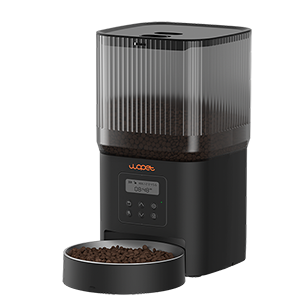
Explore this need in the finder →WOpet Cube Lite CL11 is a local timer feeder for dry food when you want to set the timetable on the appliance. Its exact manual specifies a 4 L hopper and six daily appointments. Choose it for a straightforward schedule without a phone; choose Cube Air if app-based changes are essential.
The display does the scheduling work
The CL11 manual shows a clock, meal indicators and local settings buttons. You enter the time and the food plan on the panel, rather than pair the feeder with a network to create its routine. That makes it relevant for a household that wants a self-contained setup.
A repeating schedule still needs checking. Enter the actual current time, confirm AM or PM and observe the first planned release. A successful manual-feed button press checks the mechanism, while a timed trial also checks the clock and appointment you entered.
Use 4 L and six appointments for this exact model
The CL11 manual's specification page identifies 4 L and one to six daily meals. The product page contains a 5 L marketing sentence alongside a 4 L specification table. The exact manual and table agree on 4 L, which is the capacity used here.
Think about that capacity as refill space, not a guarantee of a particular number of days. How long it lasts depends on the actual food and serving plan. Keep inspection and cleaning in the routine even if a larger reservoir would let you leave more food stored.
Food and portions need a trial with your kibble
The documented food range is dry kibble between 2 and 12 mm. Wet or damp meals do not belong in this dispensing path. Measure representative pieces, including irregular shapes, and avoid compressing the food when filling the hopper.
The portion menu sets the mechanism's release amount. Weigh several trial releases with the intended food instead of assuming every setting represents an exact number of grams. Recheck after changing recipes or reassembling the food path.
Battery information needs the manual
The manual specifies three D alkaline cells alongside a 5 V external supply. A product-page FAQ mentions two batteries, so check the actual CL11 compartment rather than buying cells from that isolated sentence. Normal panel behavior also changes on cells: the display goes off to save power.
A dark display in that mode is not automatically a fault. Use the documented controls to inspect the state and check a trial meal. For an essential routine without an outlet, compare a feeder whose primary battery operation is explicitly established rather than relying only on a long battery-life headline.
Cleaning should end with reassembly and a test
The hopper lifts off the base, and the lid has its own locking arrangement. Leave enough room around the feeder to remove and reinstall those parts. The outlet and the bowl deserve inspection as well as the visible food level.
Keep electronic parts separate from washing, dry the food-contact pieces and check the rebuilt path. Food remaining above the mechanism cannot prove the next portion will come out. A short supervised release is more useful than an unchanged screen setting after maintenance.
Where Cube Lite fits
Choose it for a locally programmed dry-food routine with up to six appointments and a single exposed bowl. Compare CA10 Cube Air for phone-based plan changes, or FlexFeed for another documented no-app timetable.
If a second cat takes the meal, local programming will not solve that different problem. Use food protection in the finder. The CL11's main value is focused timing control; it should be selected for that job rather than treated as a camera or an identity-access feeder.
Key specifications
Key details at a glance
| Dry-food compatibility | Yes |
|---|---|
| Wet-food compatibility | No |
| Timed meal releases | Yes |
| Pet-specific access control | No |
| Powered cooling | No |
| Ice-pack arrangement | No |
More specifications and setup details
| App plans or food targets | No |
|---|---|
| Local meal-schedule programming | Yes |
| Separate simultaneous feeding positions | No |
| Separate food hoppers | No |
| Maximum documented scheduled meals per day | 6 |
| Dry-food hopper volume | 4 L |
| Documented minimum regular-kibble diameter | 2 mm |
| Documented upper regular-kibble boundary | 12 mm |
Use the exact model’s instructions for operating limits, supplied equipment and version differences.
Sources for this review
Sources for this assessment
Compare the options for your routine.
Bring together the food, feeding function, controls and power that matter to you.